Author’s Creation in Circles
1. Question:

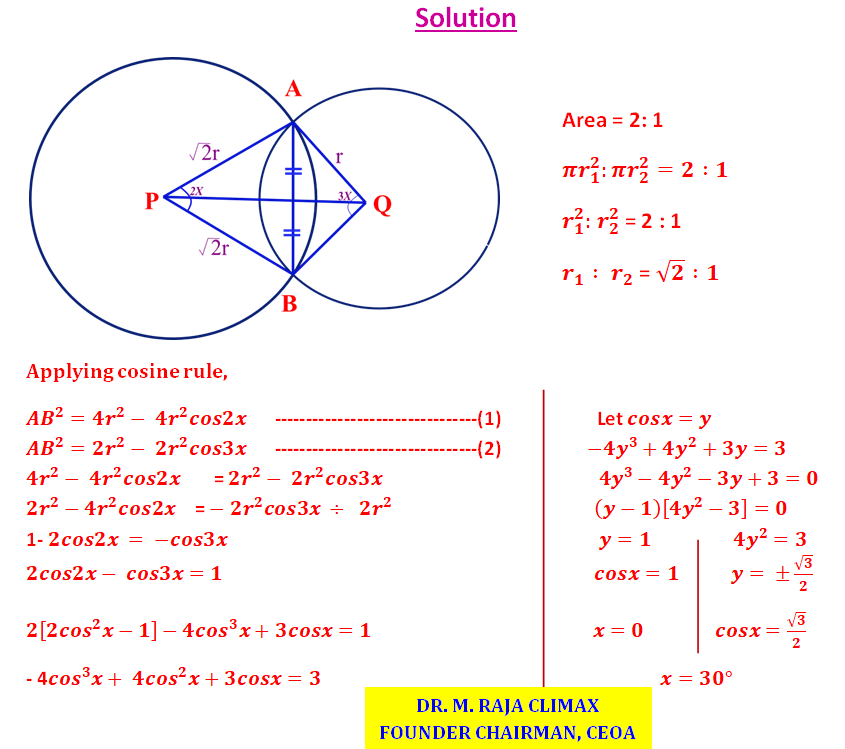
Two circles with centres at P and Q are having areas in the ratio of 2:1. They intersect each other at A & B. If ∠APB = 2x and ∠AQB = 3x, find the value of x.
Question created by
Dr.M.Raja Climax
Founder Chairman, CEOA
Comments
Test Comments Question 1
-
28-Dec-2022
test cc
- arfarahim
28-Dec-2022
Test Comment 1 Question 1
- Parthiban v
29-Dec-2022
- Ritesh Kuila
16-Mar-2023
Alternate Solution: Taking the point of intersection of PQ and AB as M, we have r.sin(3x/2) = AM = sqrt(2).r.sin(x) Cancelling common factor r, and squaring both sides, 2sin^2(x) = sin^2(3x/2) cos(2x) = 1 - 2sin^2(x) = 1 - sin^2(3x/2) = cos^2(3x/2) 2cos(2x) - 1 = 2cos^2(3x/2) - 1 That is, 2cos(2x) - 1 = cos(3x) Now proceed as in the other solution.
- Unnikrishnan
29-Jan-2024
2. Question:
Good Friday Problem

Raja, a Christian Mathematician, wanted to make a cross for Good Friday. First, he took two wooden pieces AB and CD and made a “T shape” as shown in the picture.
AB = CD = x ft.
C is also the midpoint of AB. Now he has to affix a small piece CX upon C so as to make the cross complete. He wanted to make this in such a way that X lies on the circumcircle of triangle ADB.
Find the length of CX in terms of ‘x’.
Comments
Test Comment 2 Question 2
- Parthiban v
29-Dec-2022

3. Question:
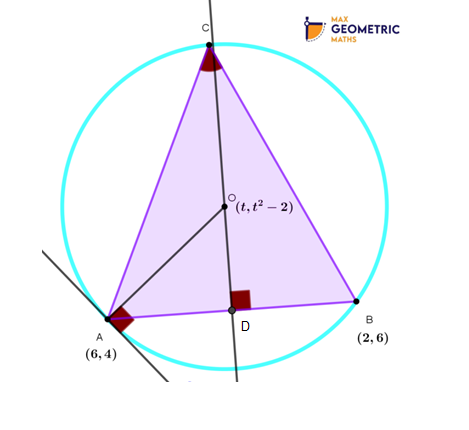
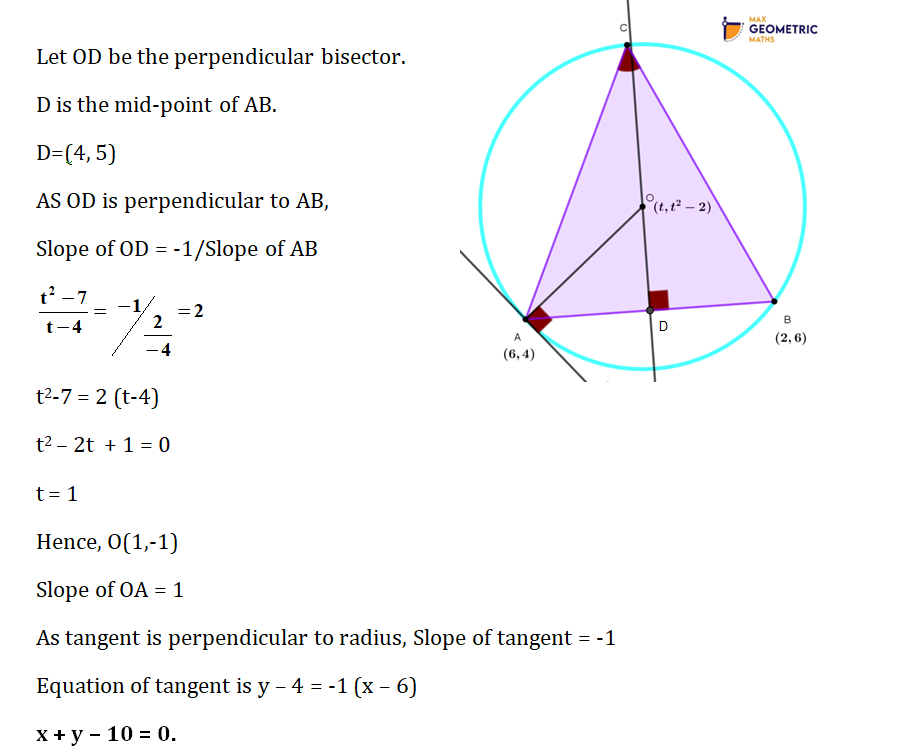
A(6,4) and B(2,6) are vertices of a Δ ABC and C is unknown. The circumcentre of the said Δ ABC is O(t, t²-2). Find the equation of the tangent to the circle at A.
Comments
Test Comment 3 Question 3
- Parthiban v
29-Dec-2022
4. Question:
The story behind the following question: Our author’s friend Mr. Lakshmana Moorthy has sent a challenging problem on two circles for solving. Our author solved the problem in no time & while sending the solution to his friend, it has become habitual for our author to send one or two & sometimes even more additional results as compliments along with the solution for receiving such challenging questions. The following is one such question.
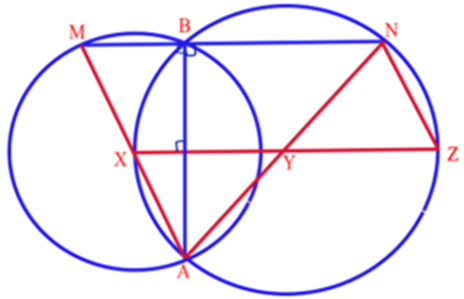
Two circles with unequal radius intersect each other at A & B and the circumference of the bigger circle passes through the centre of the smaller circle. Through B, a line perpendicular to AB is drawn cutting the circles at M & N. Prove that MN equals the diameter of the bigger circle.
Comments
Test Comment 4 Question 4
- Parthiban v
29-Dec-2022

5. Question:
The story behind the following question: Our author’s friend Mr. Lakshmana Moorthy found that the angle subtended by PQ = ∠C while drawing the figure in GeoGebra Software but he was not able to prove it theoritically. So he sent the problem to our author for solving it. Here is the solution given by our author.
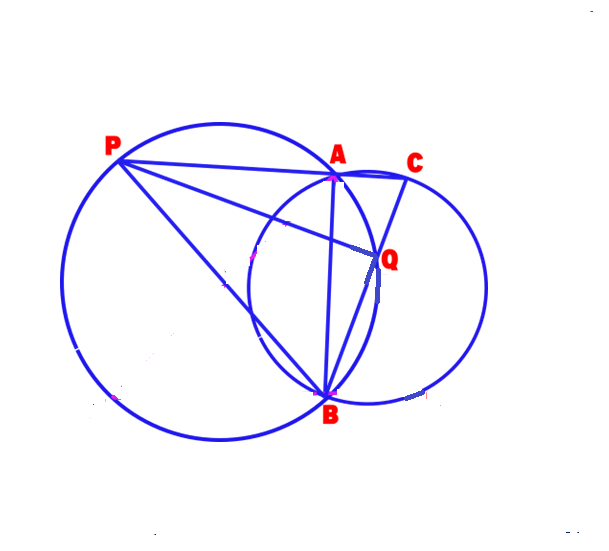
Two circles with unequal radius intersect each other at A & B and the circumference of the bigger circle passes through the centre of the smaller circle. C is a point on major arc AB of smaller circle such that CA produced cuts a bigger circle at P & CB cuts the minor arc AB of the bigger circle at Q. Prove that the angle borne by PQ on its major arc = ∠C .
Comments
test comments 5 quest ion 5
- arfarahim
29-Dec-2022
Test Comment 5 Question 5
- Parthiban v
29-Dec-2022
Hi, This is my first comment for question 5.
-
29-Dec-2022

6. Question:

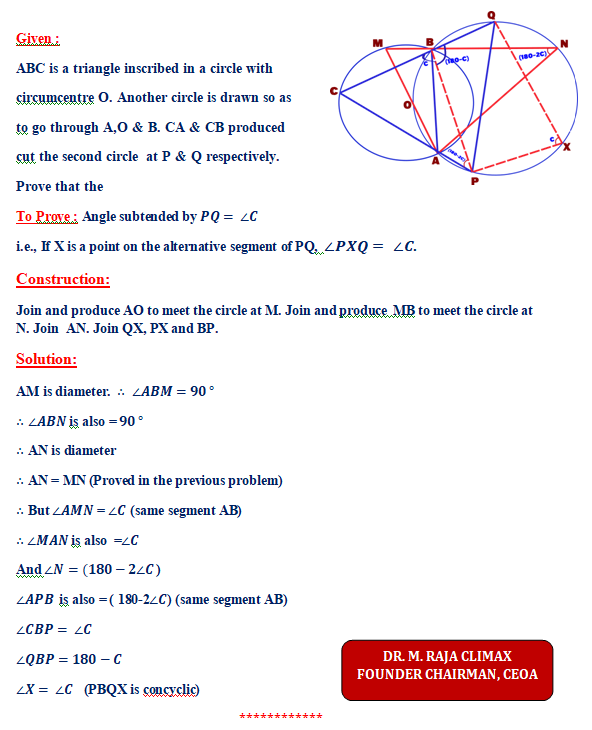
ABC is a triangle inscribed in a circle with circumcentre O. Another circle is drawn so as to go through A, O & B. CA & CB produced cut the second circle at P & Q respectively. Prove that the angle subtended by PQ = ∠C.
Comments
Test Comment 6 Question 6
- Parthiban v
29-Dec-2022
7. Question:
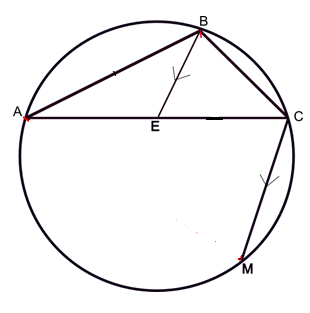
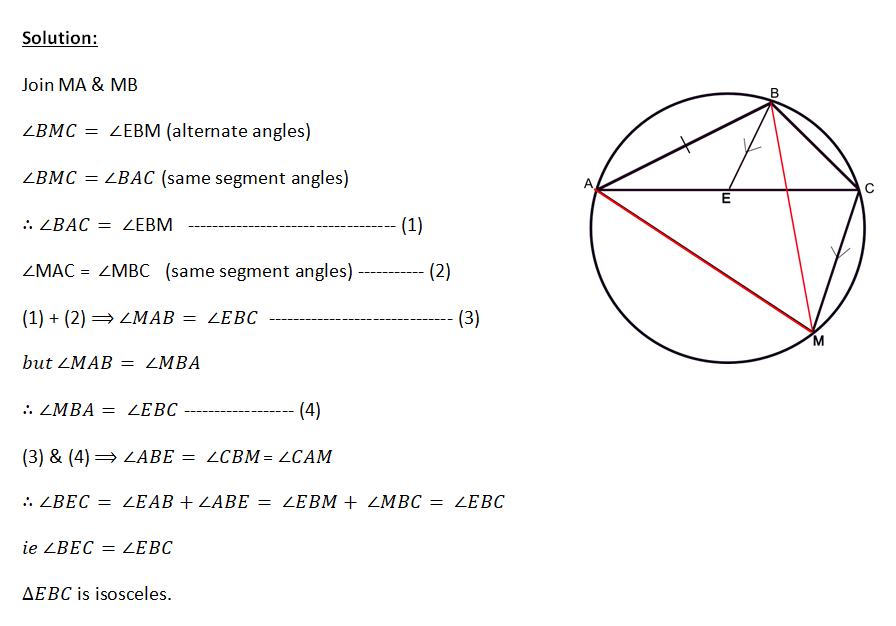
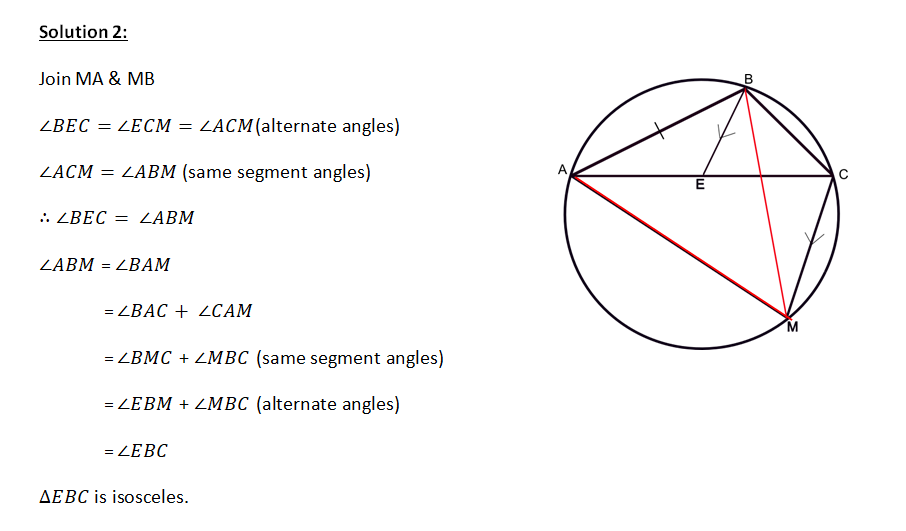
ABC is a triangle inscribed in a circle with AC > BC. M is the midpoint of major arc AB. A line is drawn parallel to MC through B meets AC at E. Prove that is isosceles .
Comments
Test Comment 7 Question 7
- Parthiban v
29-Dec-2022
8. Question:
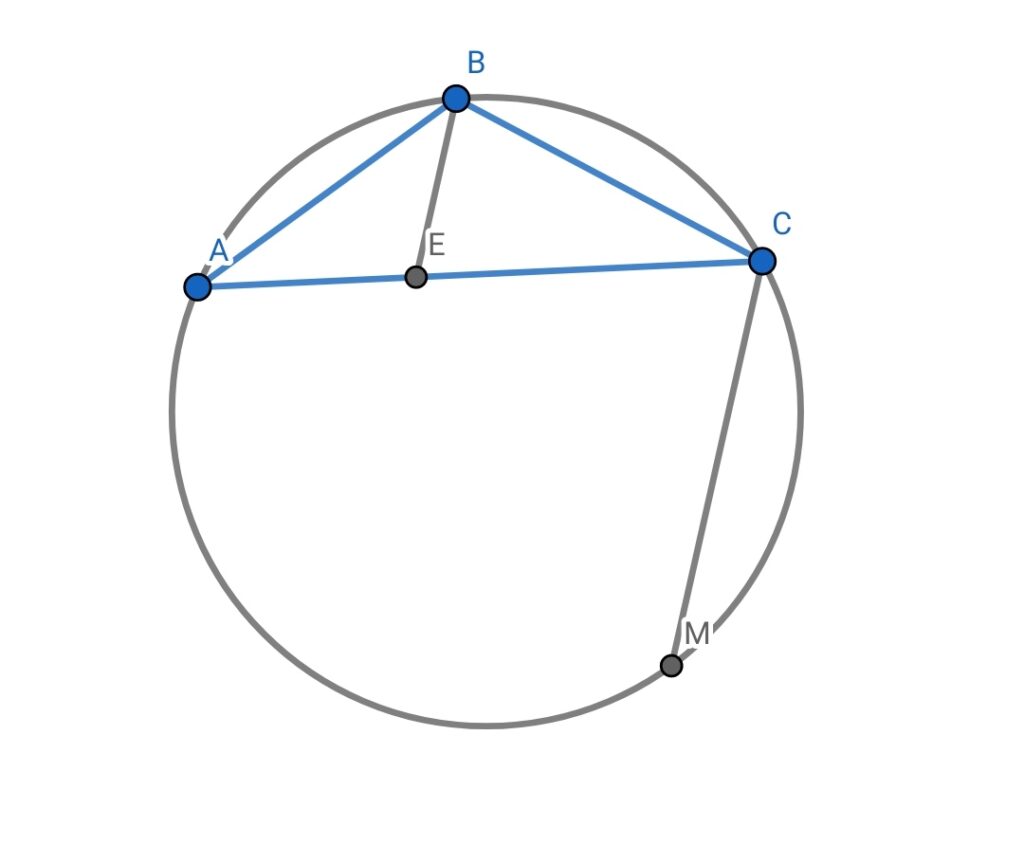
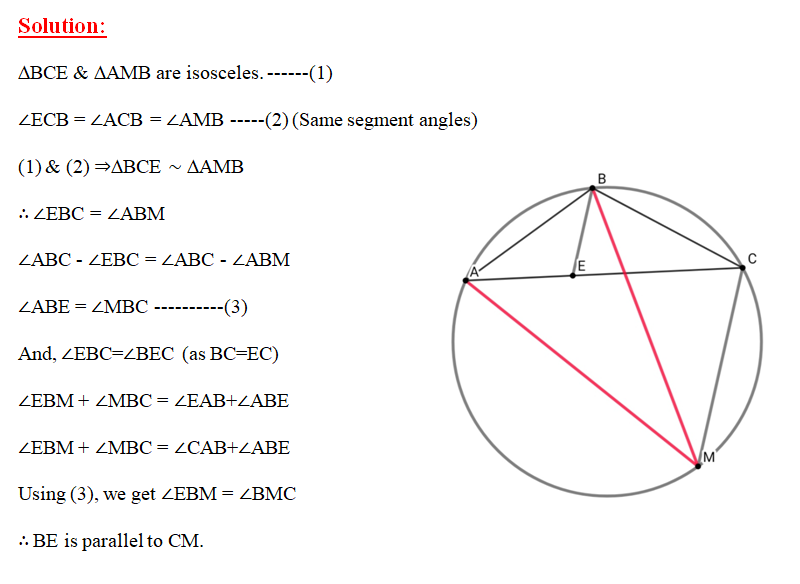
ABC is a triangle inscribed in a circle with AC > BC. M is the midpoint of major arc AB. If E is a point on BC such that BE=EC, then prove that BE is parallel to CM.
Comments
Test Comment 8 Question 8
- Parthiban v
29-Dec-2022

9. Question:

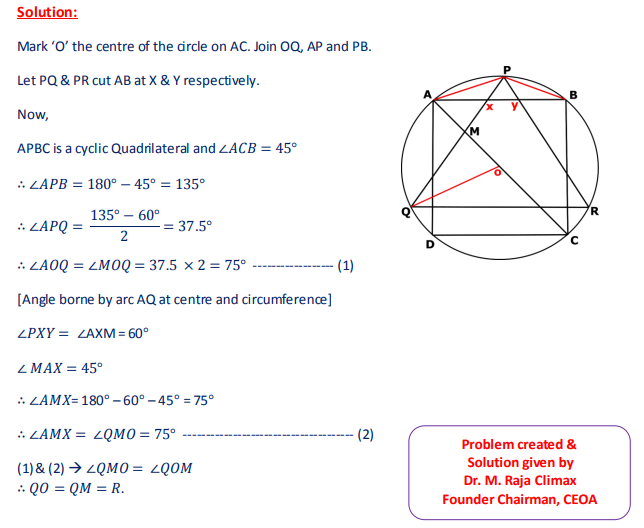
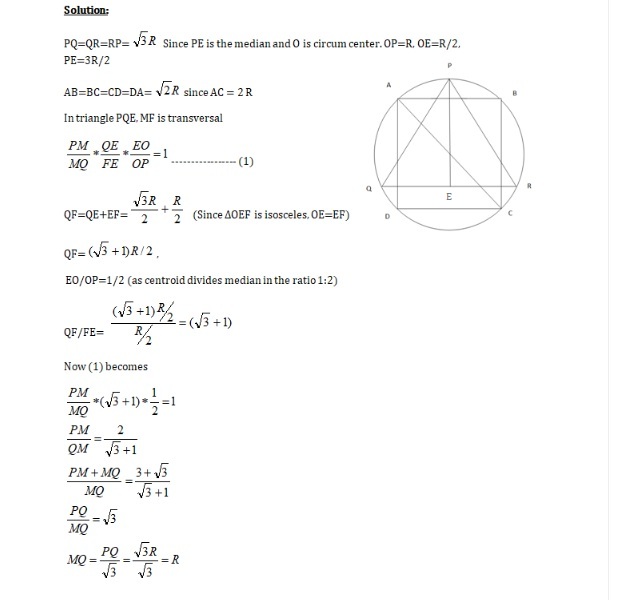
In the given picture, the square ABCD and the equilateral triangle PQR are inscribed in the circle such that QR is parallel to AB & CD. AC & PQ cut at M. Prove that MQ = R, the radius of the circle.
Comments
Test Comment 9 Question 9
- Parthiban v
29-Dec-2022
10. Question:
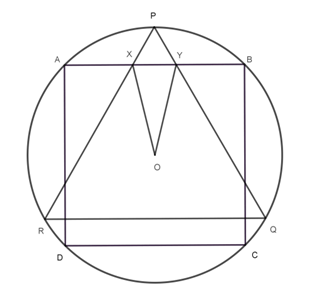
A square ABCD and an equilateral triangle PQR are inscribed in a circle centered at O in such a way that AB is parallel to QR. The sides PQ and PR of the triangle meet the side AB of the square at X and Y respectively. Find the value of ∠RQC
Comments
Test Comment 10 Question 10
- Parthiban v
29-Dec-2022

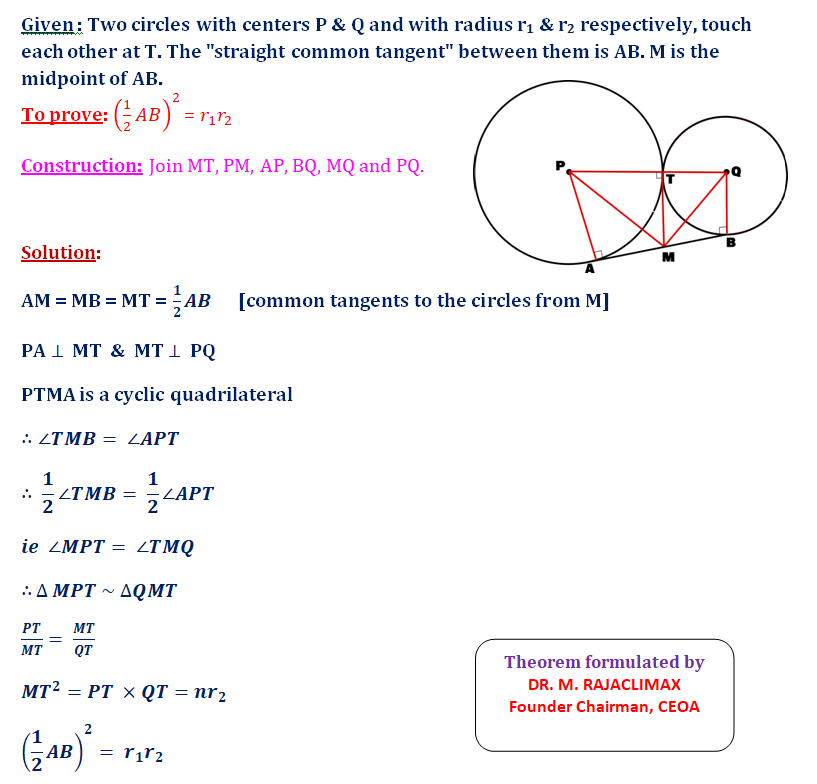
11. Common Tangent Theorem

Comments
Test Comment 11 Question 11
- Parthiban v
29-Dec-2022
12. Question:
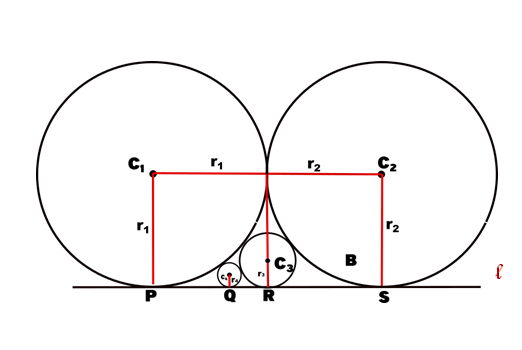
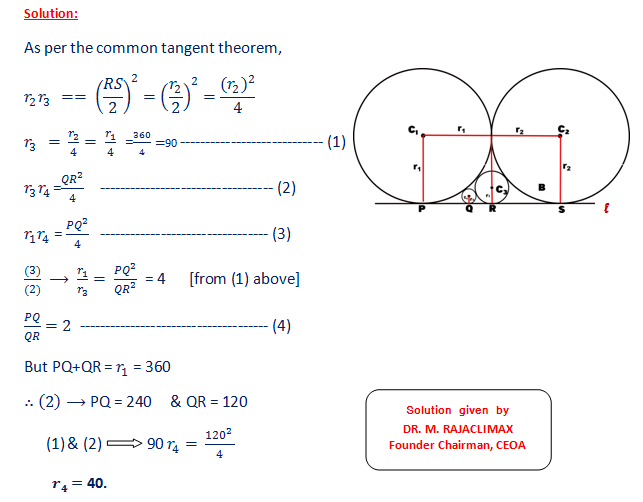
As shown in the figure below, circles C1 of C2 of radius 360 are tangent to each other, and both tangent to straight l . If circle C3 is tangent to C1, C2 and l ,and circle C4 is tangent to C1, C3 and l , find the radius of C4.
Comments
Test Comment 12 Question 12
- Parthiban v
29-Dec-2022
13. Question:
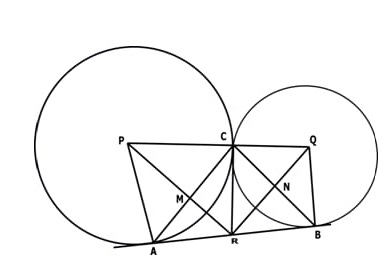
In the picture two circles with centres P & Q touch each other at C. AB is their common tangent. Identify & write down the triangles that are similar to ABC.
Comments
Test Comment 13 Question 13
- Parthiban v
29-Dec-2022

Author’s Creation in Triangles
1. Question:
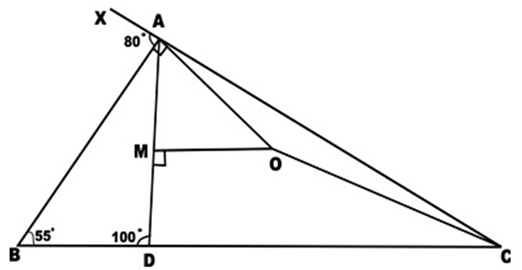
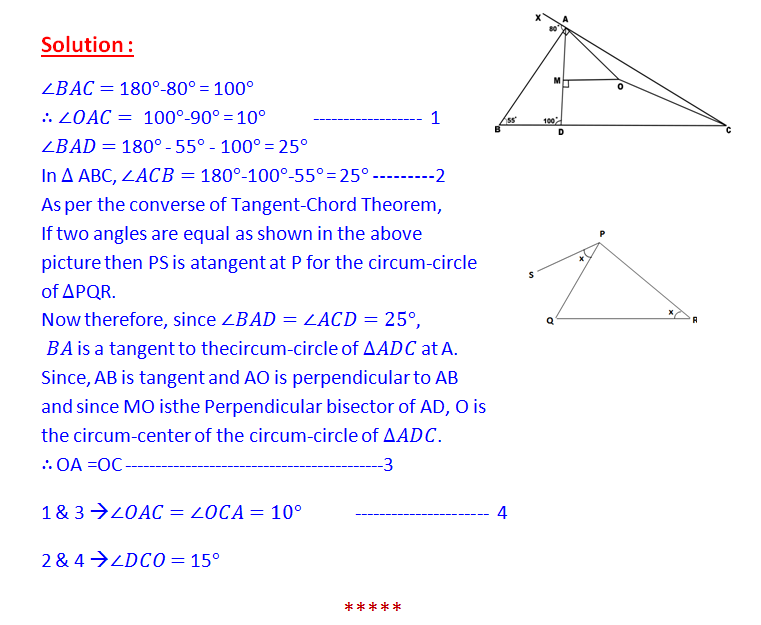
In Δ ABC, ∠B = 55°. AD is a cevian such that ∠ADB = 100°. CA is produced to X and ∠BAX = 80°. M is the midpoint of AD. The perpendicular line drawn to AD through M and the perpendicular line drawn to AB through A meet at O. Find the measurement of ∠DCO.
2. Question:
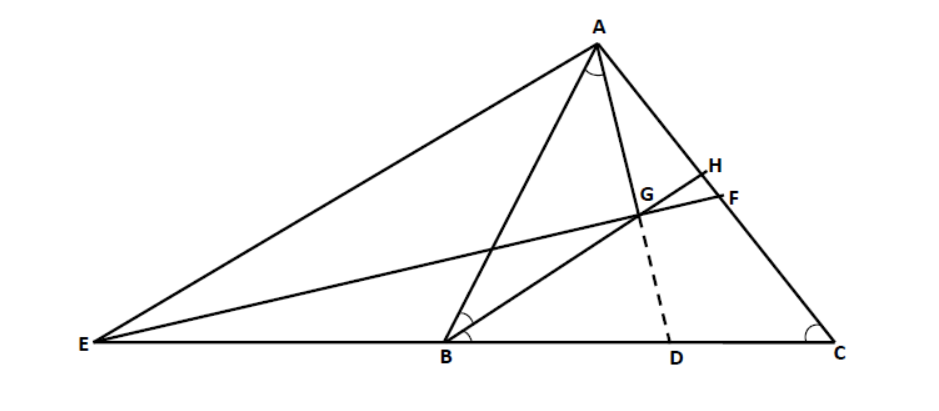
The story behind the problem: The author received the problem ‘In Δ ABC, BH is the bisector of ∠ B meeting AC at H. CB is produced to E such that AB =BE. F is the midpoint of AC. EF and BH meet at G and AG is joined. Prove that ∠BAG=∠C’ from his Vijayawada Friend Mr. Lakshmana Moorthy. He started to solve the problem by his favourite angle bisector theorem & Menelaus theorem but he could not complete it because of his busy schedule. So he forgot about that problem later. After two months, during lock down all of a sudden he remembered that he didn’t solve the problem. So he immediately rang up to his friend and enquired whether anyone solved it in these two months gap. But his friend replied that no one could solve it. Again, he sat with that problem & found the solution. His friend was very much excited when he heard that our author has solved the problem which no geometricians could solve. Based on the problem, he received from his friend, he extended the result & found the below result as its corollary.
In Δ ABC, BH is the bisector of ∠ B meeting AC at H. CB is produced to E such that AB =BE. F is the midpoint of AC. EF and BH meet at G and AG is joined. Prove that AG = AH
3. Question:
4. Question:

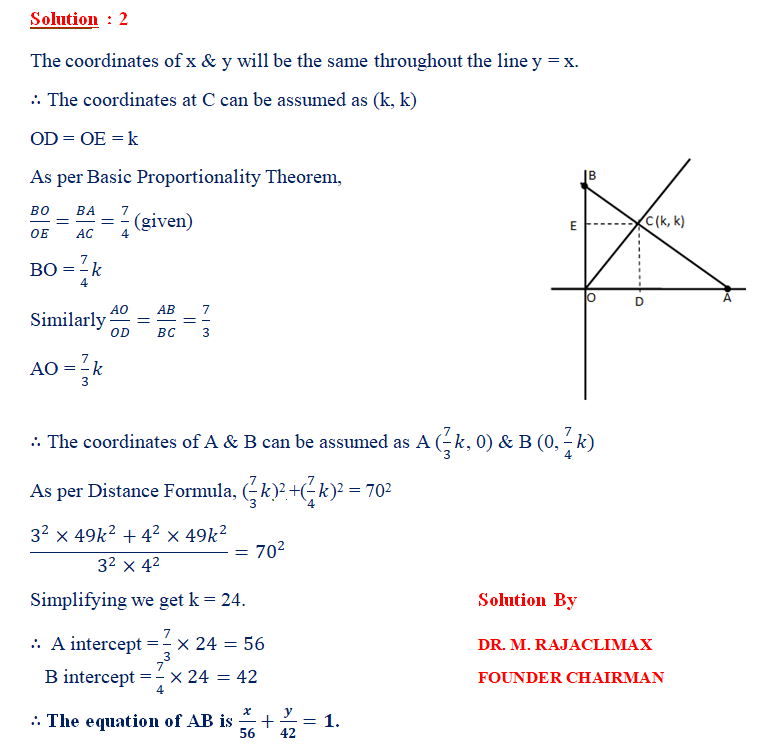
A straight line makes positive intercepts on the x & y axis at A & B respectively. The distance between A & B is 70 units. Another straight line y = x intersects AB at C and AC : CB = 4:3. Find the equation of the straight line AB.


6. Question:

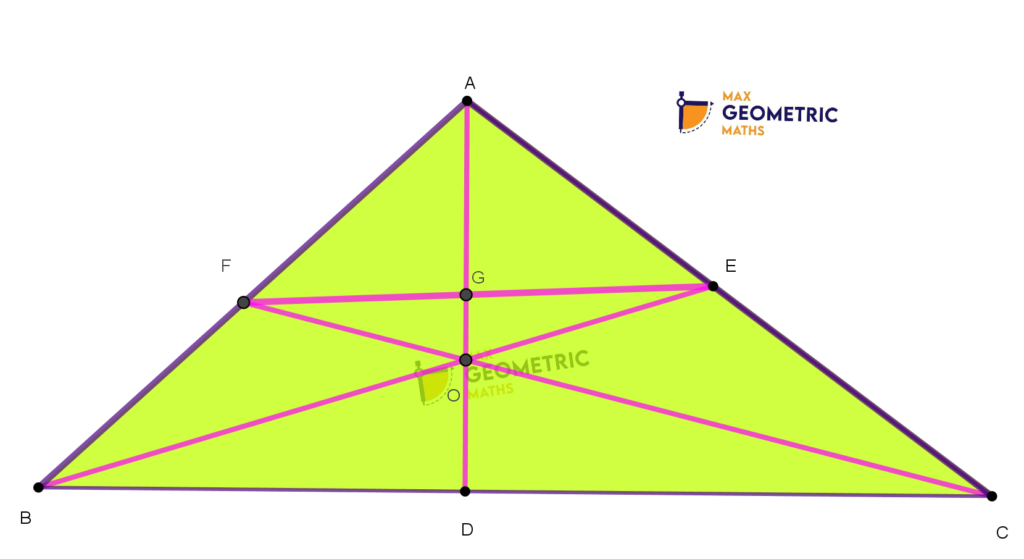
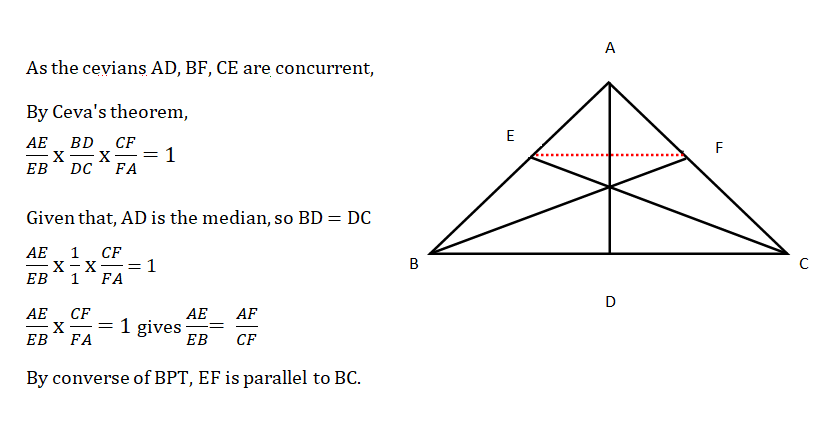
For the below result, the Geometricians across the world have given their own lengthy proofs. But the author has proved this result very simply in just two steps using ceva’s theorem.
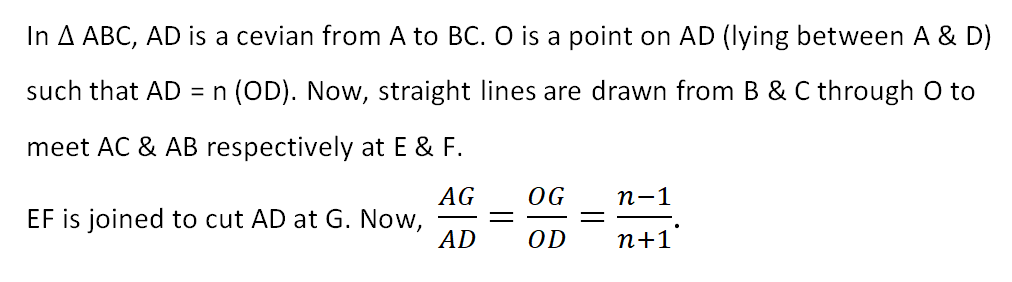
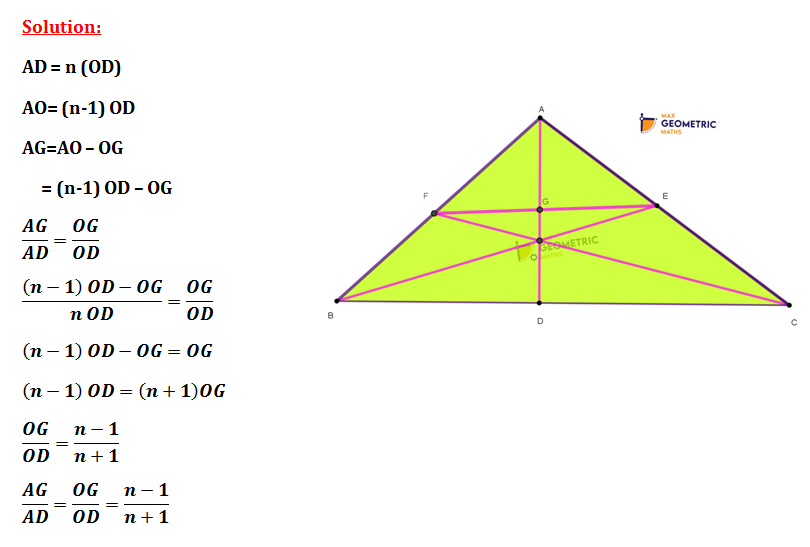
In Δ ABC, AD is the median meeting BC at D. ‘O’ is a point on AD. If cevians drawn from B & C through ‘O’ meet AC & AB respectively at F & E, then EF is parallel to BC
7. Question:

8. Question:

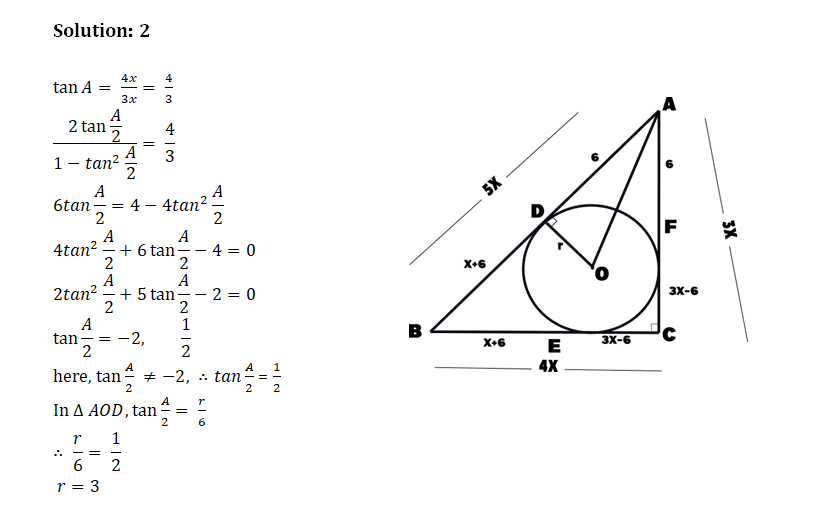
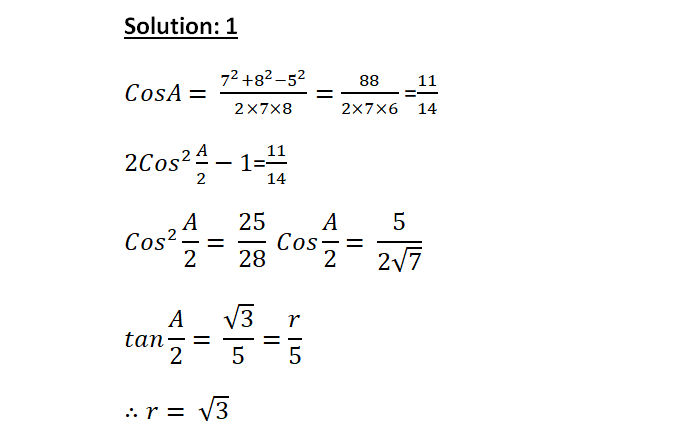
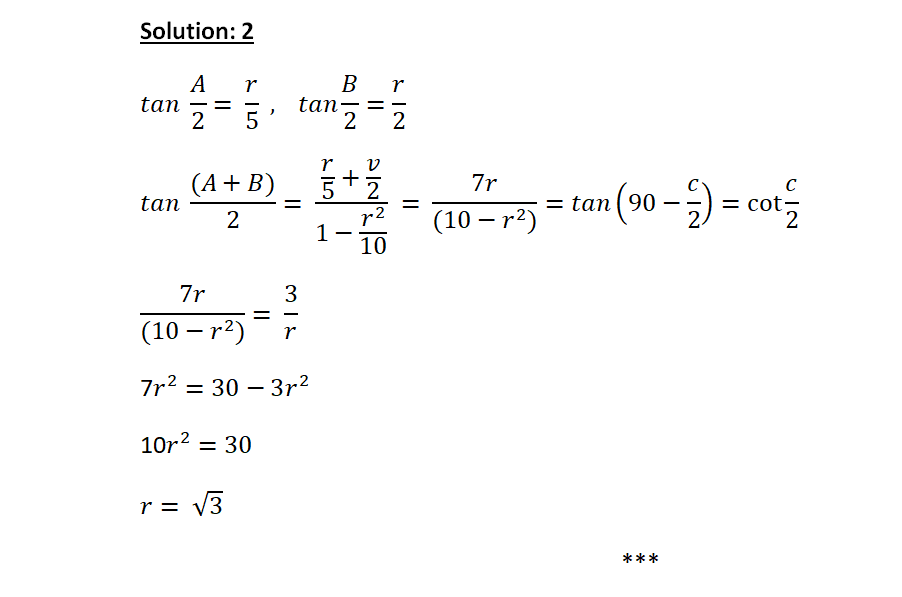
ABC is a triangle circumscribing a circle of radius ‘r’ cm. Let D, E, F be the point of contracts as shown in the figure. If AD = 6 cm & AC : BC : AB = 3 : 4 : 5. Find the value of r

9. Question:

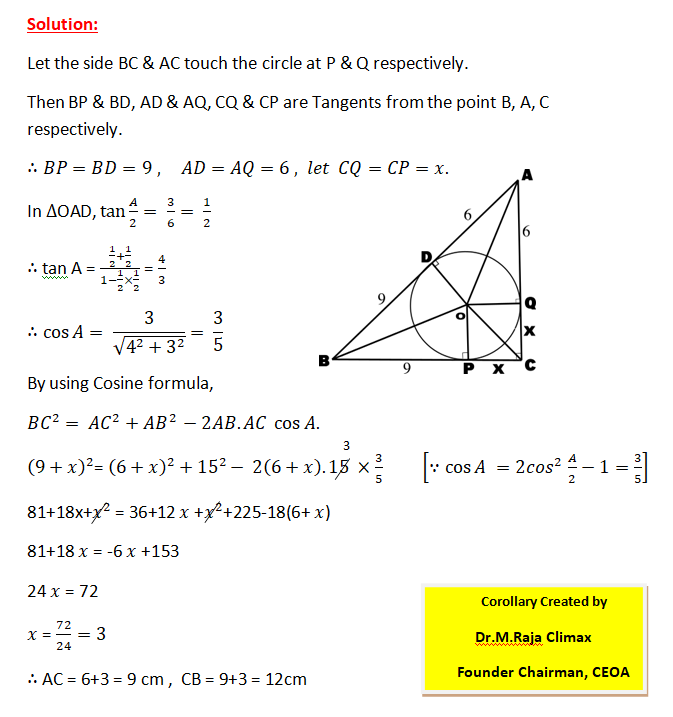
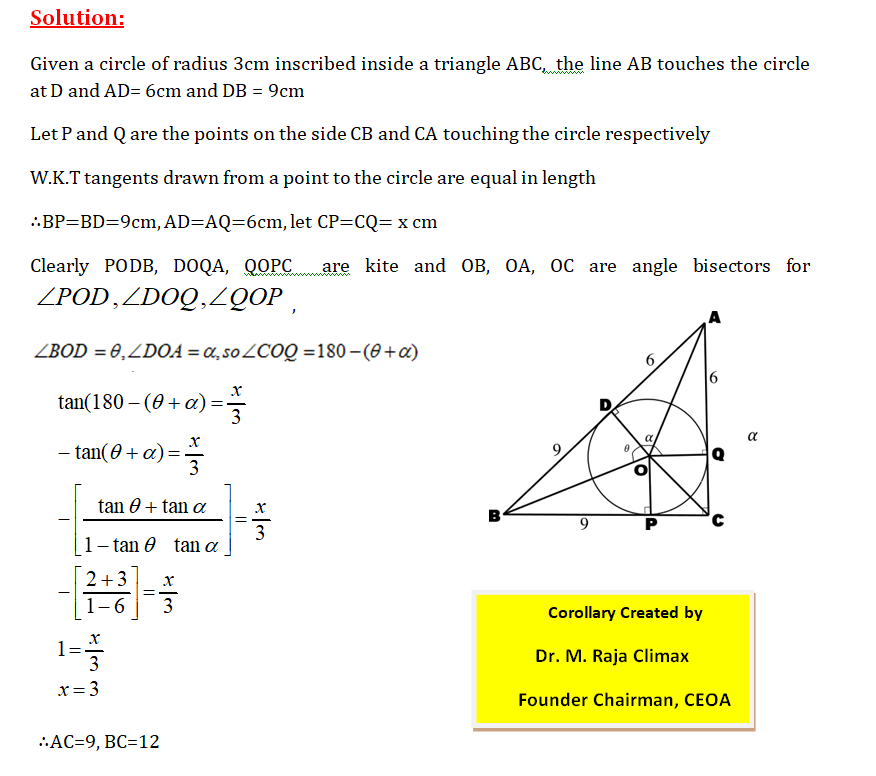
A triangle ABC is drawn to circumscribe a circle of radius 3 cm such that the segments AD & DB into which AB is divided by the point of contact D are of lengths 6 cm and 9 cm respectively. Find the sides AC & BC.
10. Question:
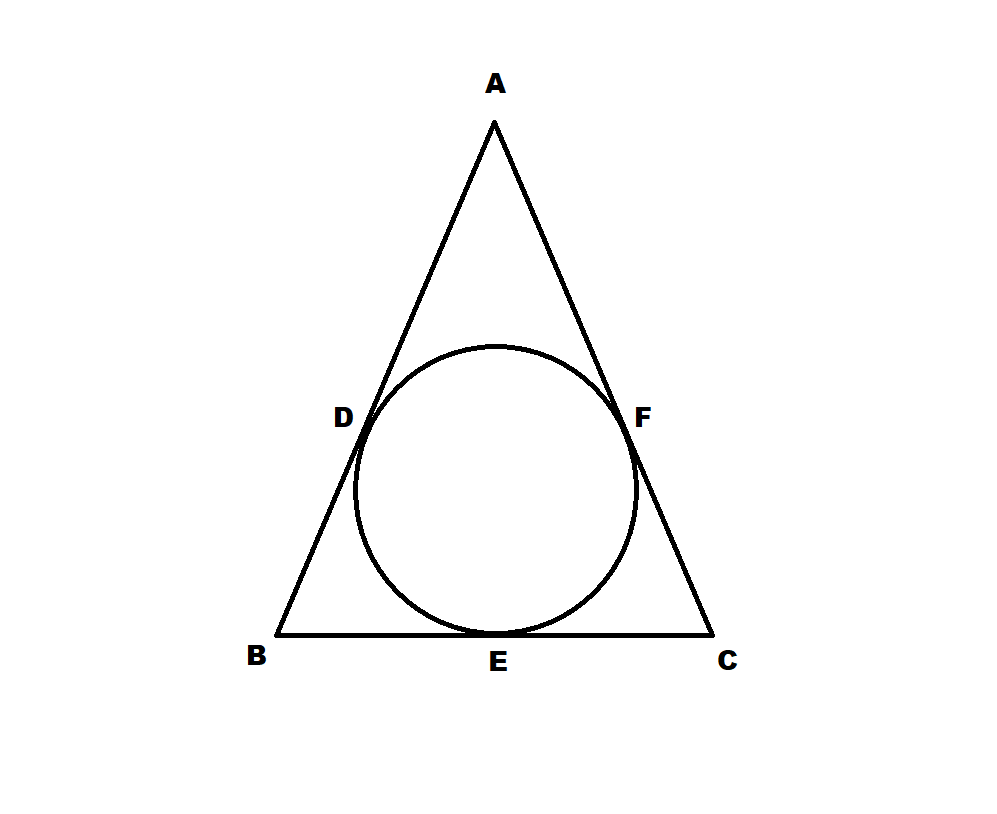
ABC is an ordinary triangle, AB:BC:CA = 7:5:8. Its incircle touches AB at D, if AD = 5cm, find the radius of the incircle.
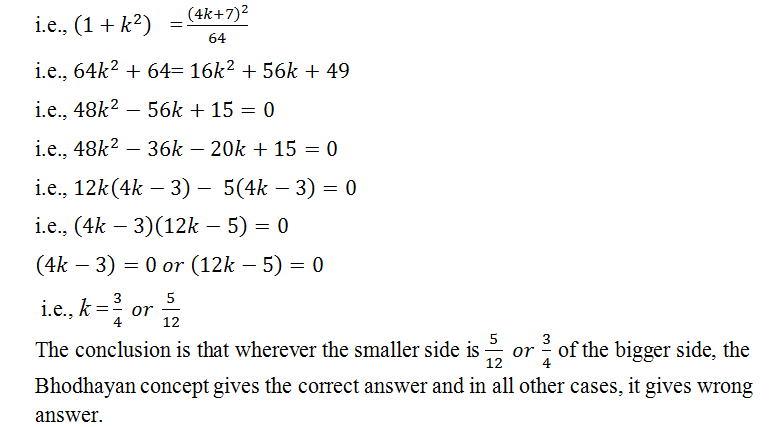
11. An Essay on Pythagoras Theorem


Dr.M.Raja Climax
Founder Chairman, CEOA
12. Question:

In ∆ 𝑨𝑩𝑪, BP & CQ are cevians intersecting each other at O. Area ∆ 𝑩𝑶𝑸 = 𝒂 ,𝑨𝒓𝒆𝒂 ∆ 𝑩𝑶𝑪 = 𝒃 𝒂𝒏𝒅 𝑨𝒓𝒆𝒂 ∆ 𝑪𝑶𝑷 = 𝒄. Find the area of Quadrilateral AQOP in terms of a, b & c

13. Question:
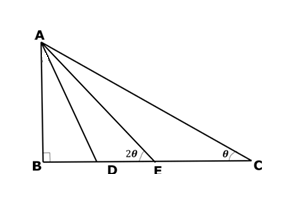

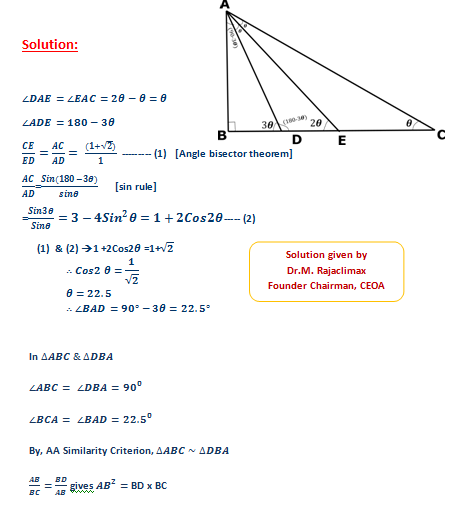
14. Question:
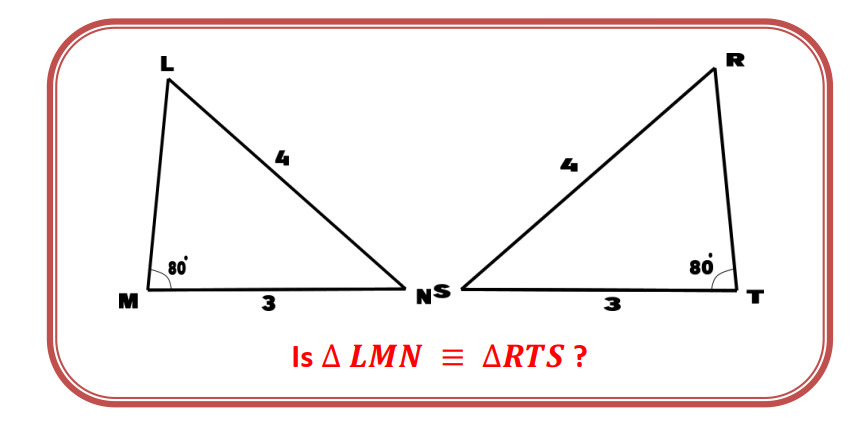
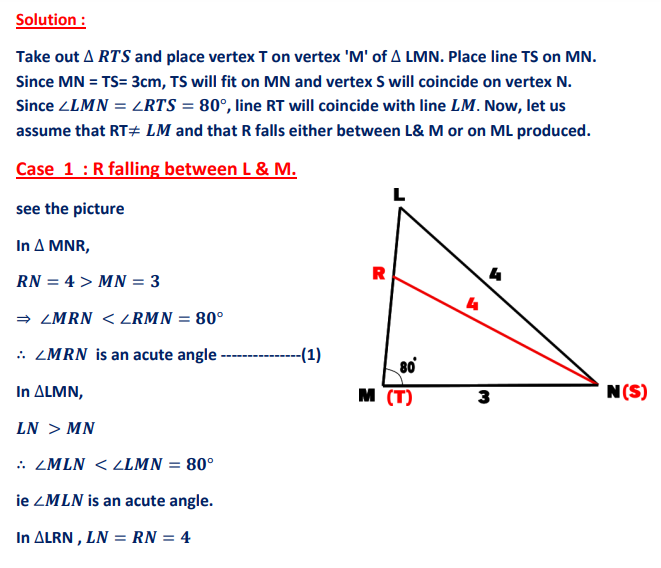
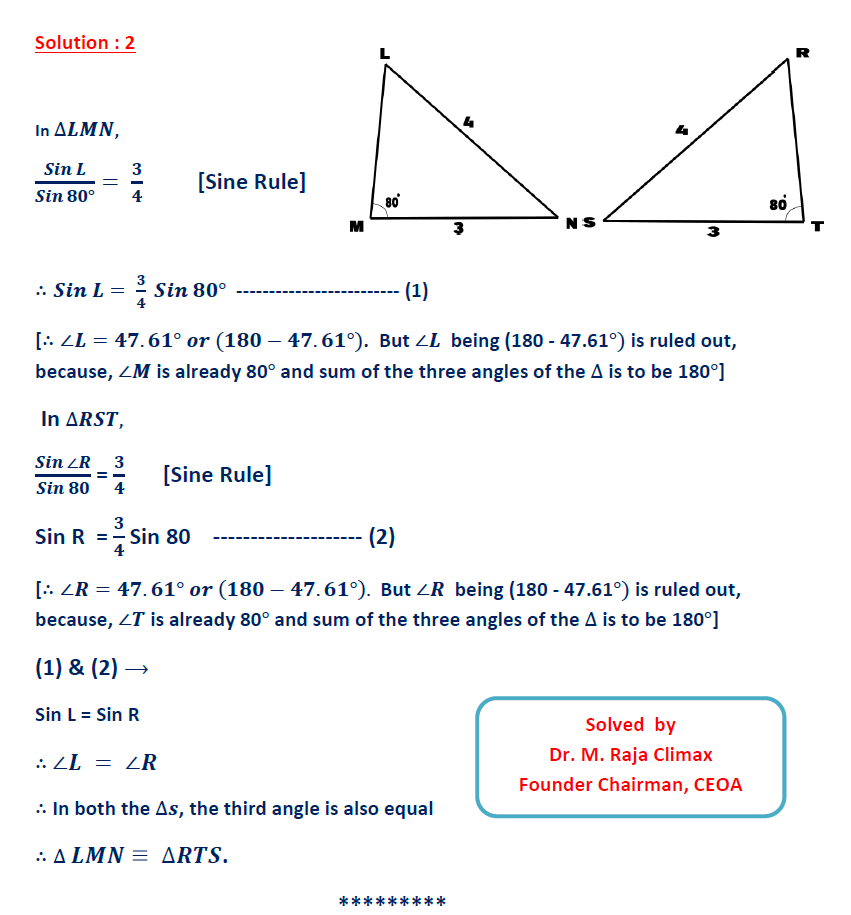
15. An article on Congruency
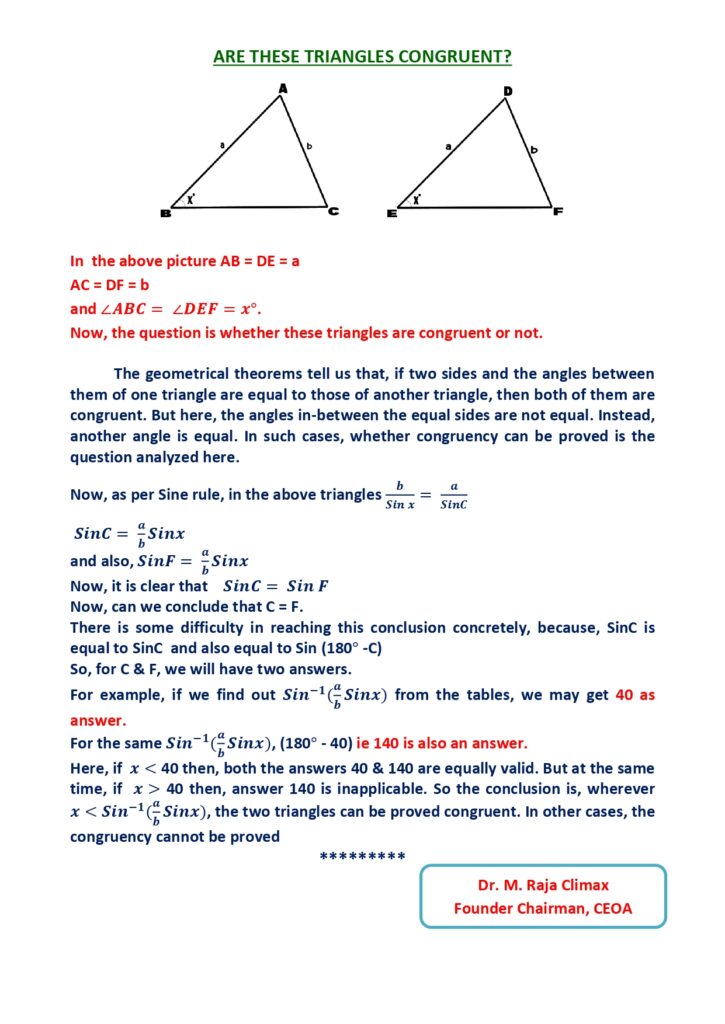
16. Question:

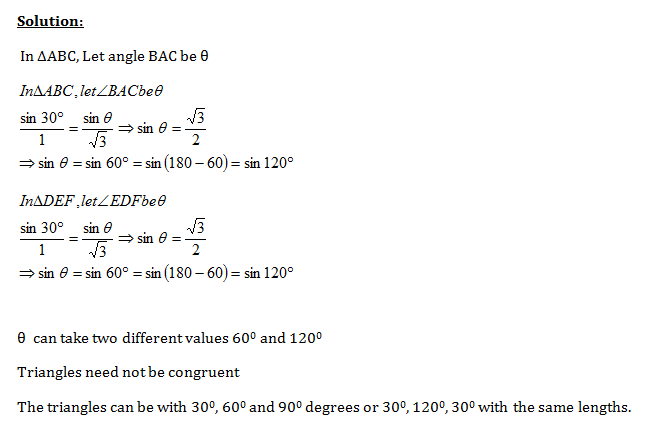
In ΔABC & ΔDEF, BC=EF=√3 , AC=DF=1, ∠ABC=∠DEF=30°. Check whether the triangles are congruent?
17. Question:
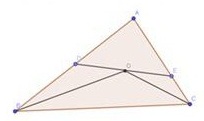
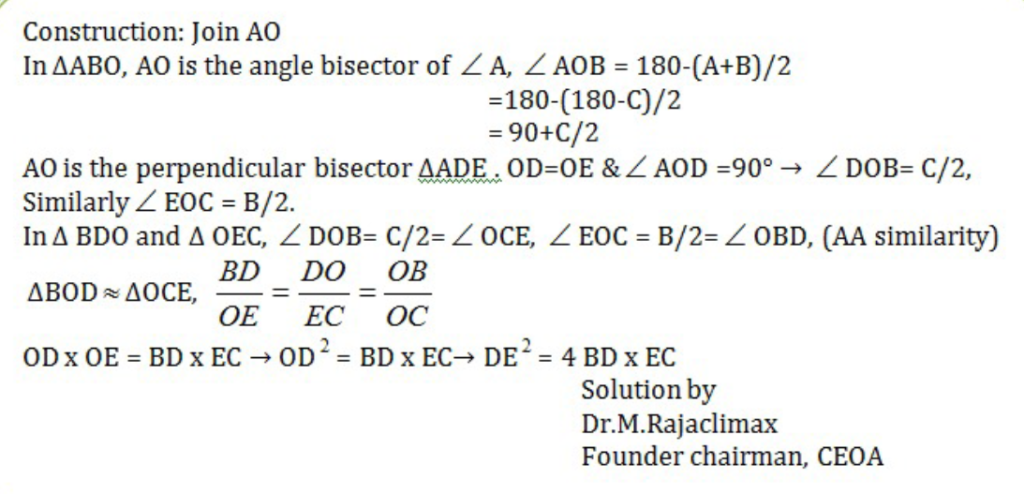
In a ΔABC, the bisectors of ∠B & ∠C meet at 0.DE isa straight line drawn through O such that AD=AE. Prove that DE2= 4 (BD x CE)
Question created by
Dr.M.Raja Climax
Founder Chairman, CEOA
Author’s Creation in Quadrilaterals
1. Question:
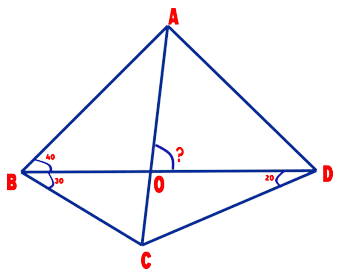
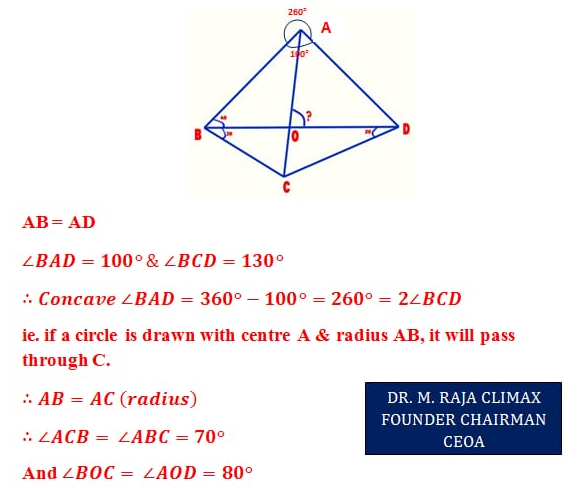
In quadrilateral ABCD, AC & BD meet at O; AB = AD; ∠ABD = 40°; ∠CBD = 30°; and ∠BDC = 20°. Find the measurement of ∠AOD.
Question created by
Dr.M.Raja Climax
Founder Chairman, CEOA
2. Question:
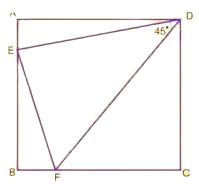
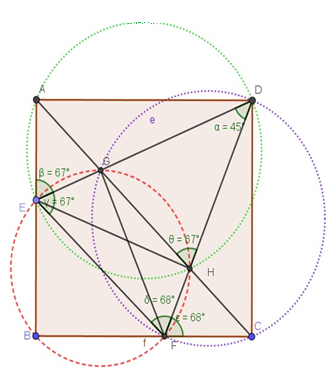
ABCD is a square. E & F are points on AB & BC respectively such that ∠EDF=45º. Prove that ED & FD are the bisectors of ∠AEF & ∠CFE

3. Question:
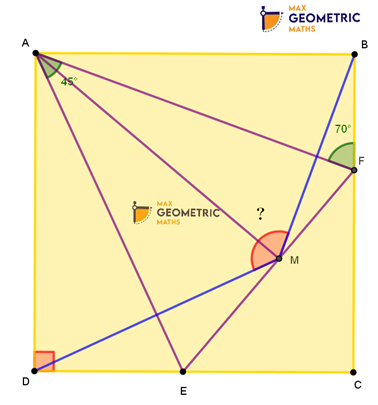
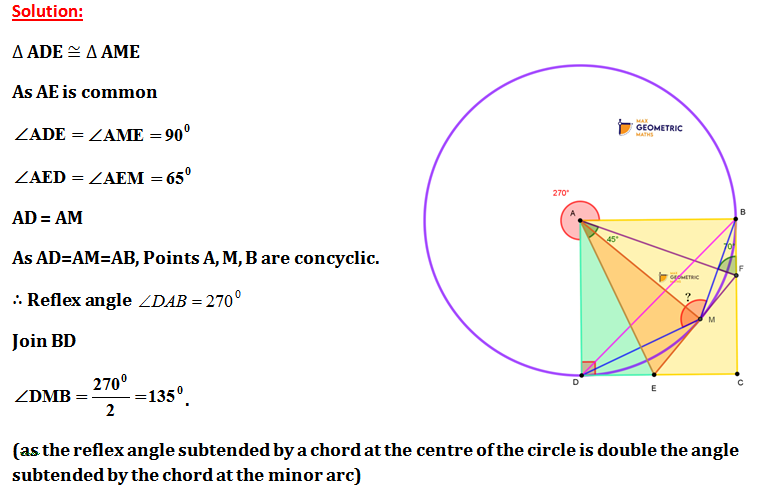
ABCD is a square. E & F are points on DC& BD respectively such that ∠EAF =45°& ∠AFB =70° as shown in the figure. Ifa perpendicular is drawn from Ato EF meeting EF at M, then find ∠DMB
4. Question:
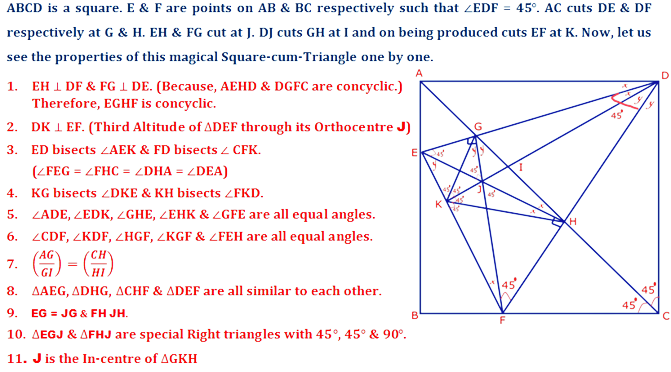
Research done by
Dr.M.Raja Climax
Prof G. LAKSHMANA MURTHY.
5. Question:

In the above figure, ‘O’ is the orthocentre of Δ ABC. Identify & write the cyclic quadrilaterals figuring inside ΔABC.

6. Question:
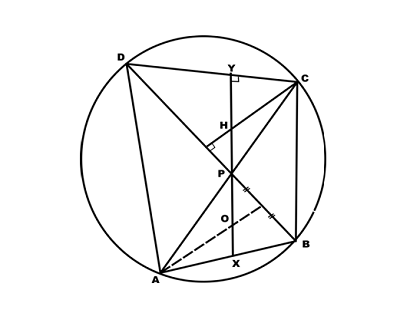
Modified Rider :
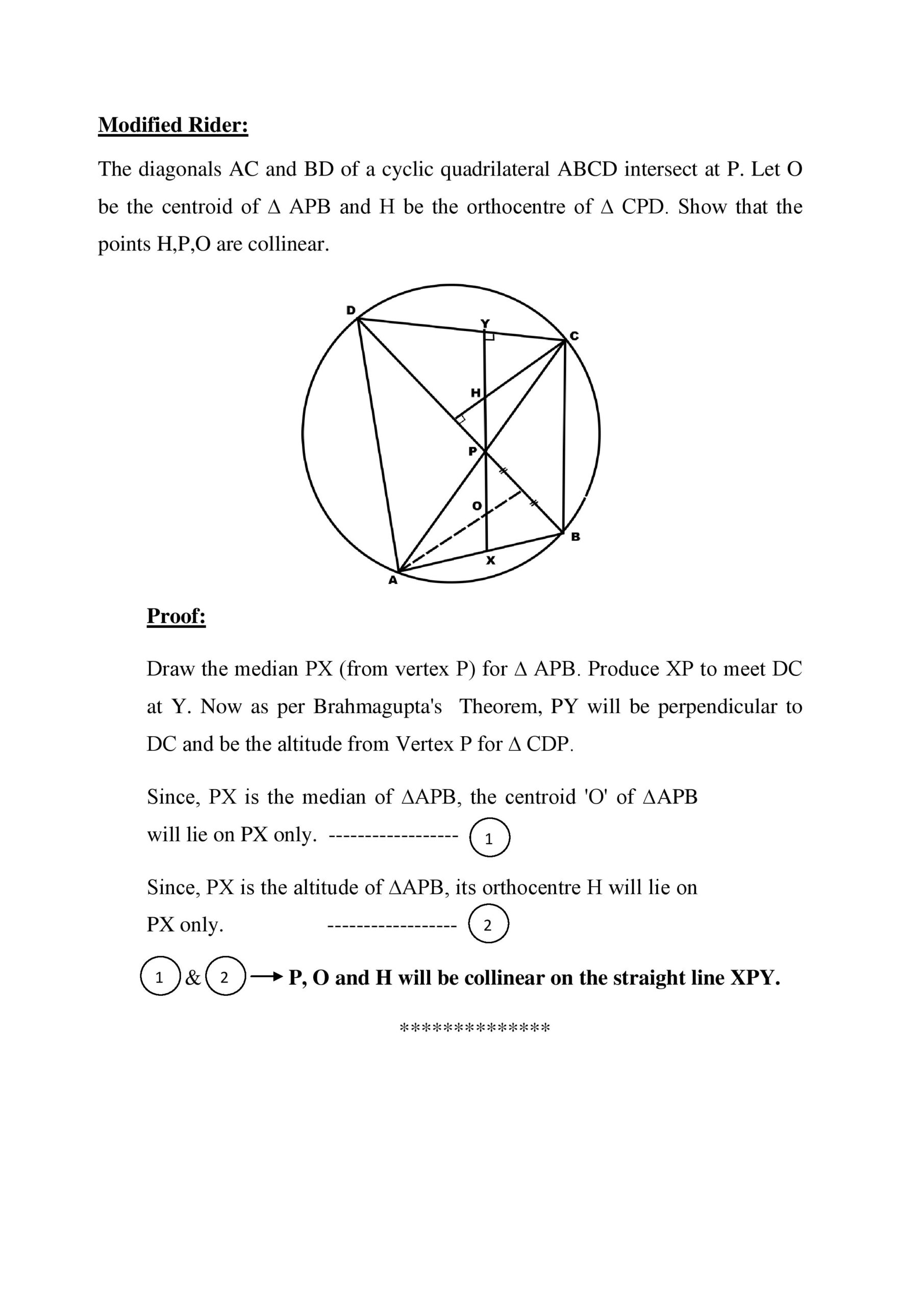
The diagonals AC and BD of a cyclic quadrilateral ABCD intersect at P. Let O be the centroid of ∆APB and H be the orthocentre of ∆CPD. Show that the points H,P,O are collinear.
7. Question:

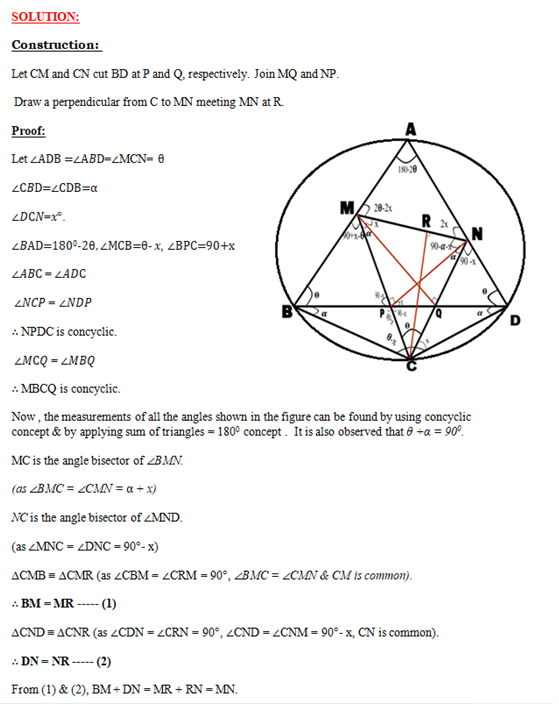
ABCD is a Cyclic quadrilateral with AB = AD and CB = CD. M and N are points on AB and AD respectively such that ∠MCN = ∠ABD. Prove that MN = MB + ND.
8. Question:
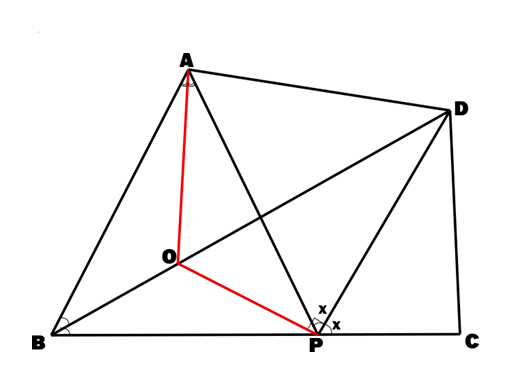
Given a quadrilateral ABCD where BD bisects ∠B , P is a point on BC such that PD bisects ∠APC. Show that ∠BDP + ∠PAD = 90°
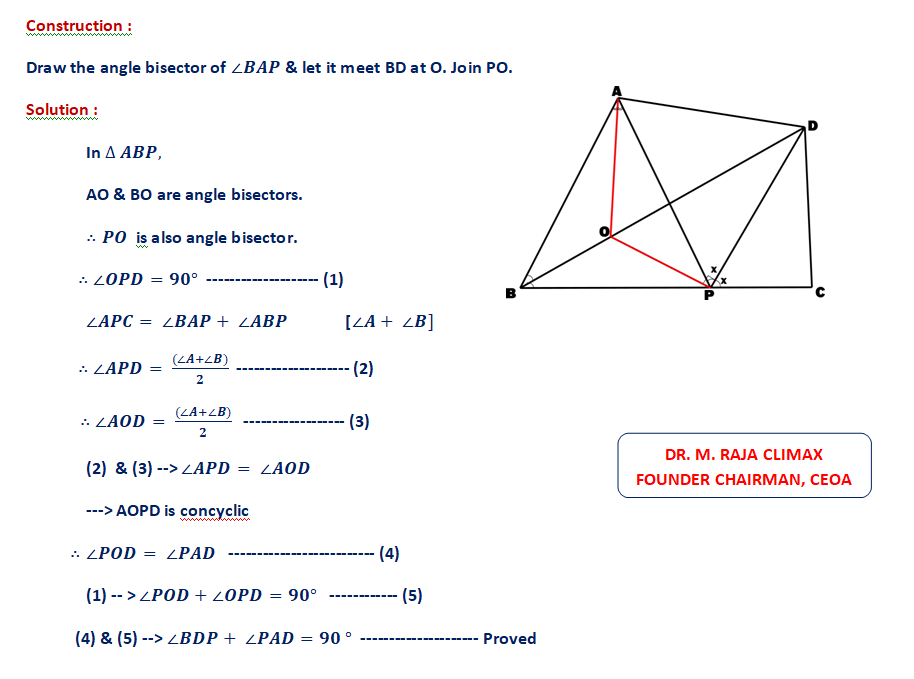
Click here to view the problem in GeoGebra.
https://www.geogebra.org/m/yanv3fgjAuthor’s Creation in Mensuration
1. Question:
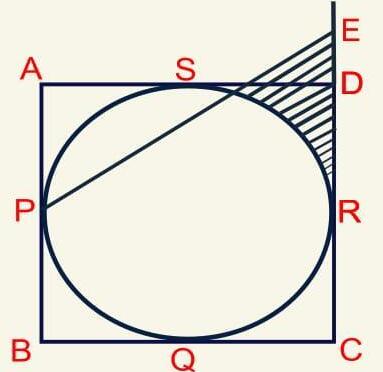
ABCD is a square with area 300 sq.units. A circle is inscribed inside the square ABCD, as shown in the picture, touching its sides at P,Q,R and S. RD is produced to E such that RE = 10 units and EP is joined. Find the area of the shaded portion.
Problem created by
- Dr.M.Raja Climax,
FOUNDER CHAIRMAN, CEOA

2. Question:
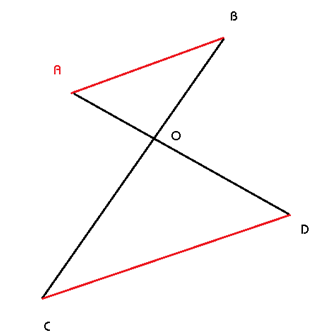
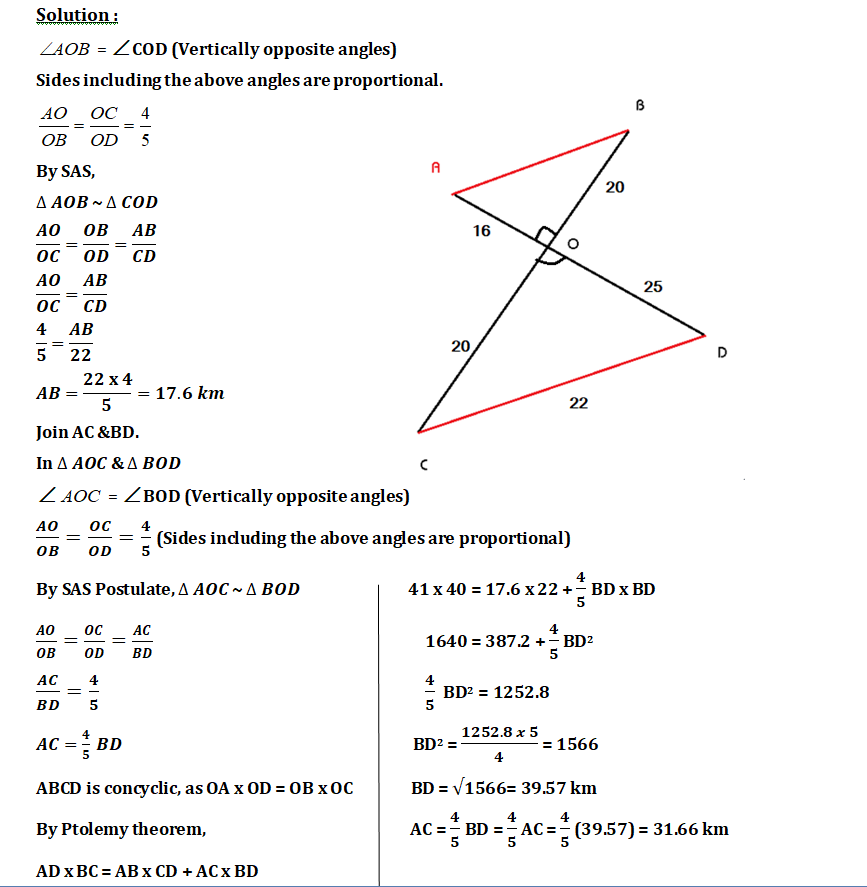
There are four towns, viz A, B, C and D located and connected by roads as shown in the picture. All the roads are on straight lines. Road AD and Road BC meet at O. O is also the midpoint of BC. Road AD = 41 KM, Road BC = 40 KM, Road OD = 25 KM and road DC = 22 KM. Find the length of Road AB.
3. Question:
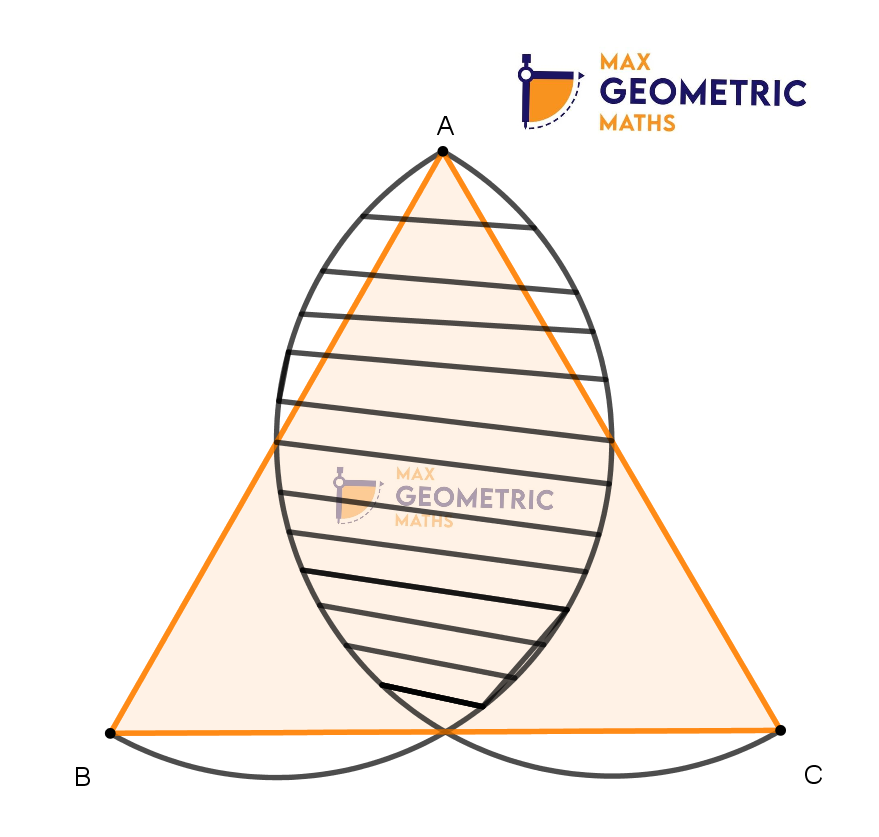
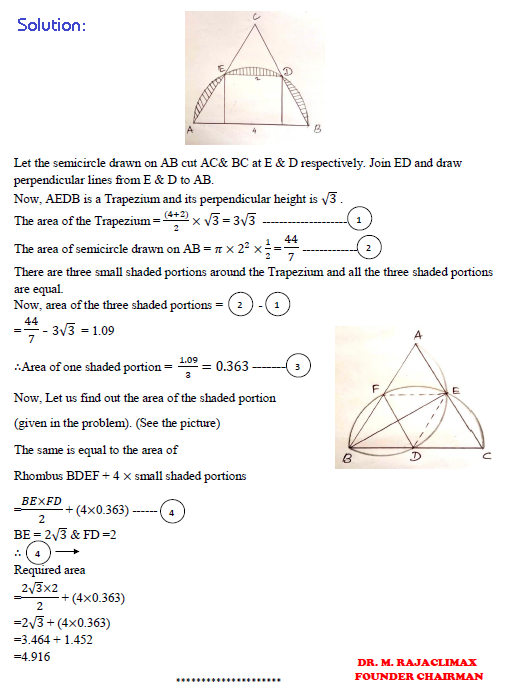
If ABC is an equilateral triangle, find the area of the shaded region.
Author’s Creation in Trigonometry
1. Question:
HUNTER-BIRD PROBLEM
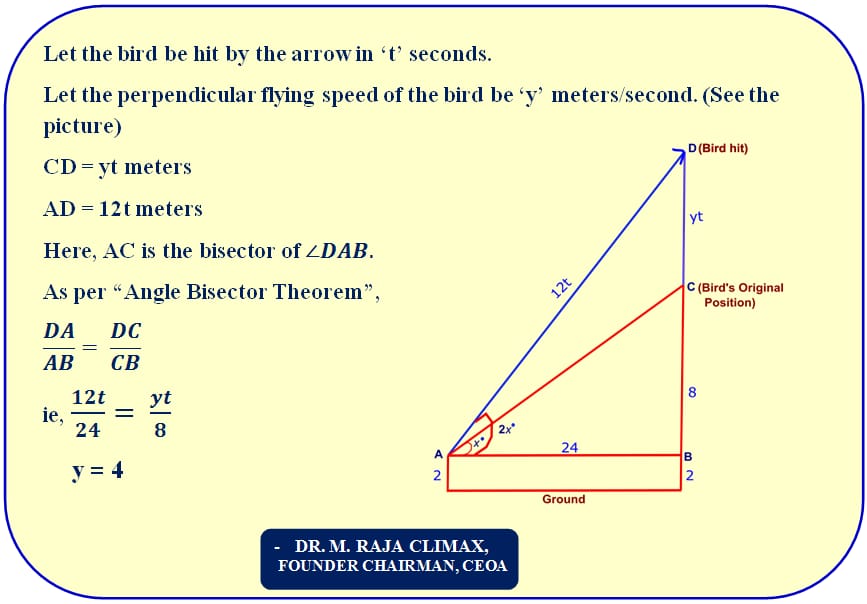
A hunter (his height is 2 meters) was standing at a distance
of 24 meters from a pole of height 10 meters, aiming his
bow and arrow at a bird sitting on the top of the pole. The
angle of elevation of the bird from his eyes was x°. The
hunter knew that on hearing the sound of the release of the
arrow from the bow, the bird would suddenly fly
perpendicular to the ground and therefore, he had to shoot
his arrow at a degree higher than x° so that the arrow
would hit the bird while flying perpendicularly above the
pole. The speed of his arrow was 12 meters per second. He
aimed his arrow at 2x° and released it. The bird on hearing
the release -sound flied above the pole perpendicularly but
it was hit by the arrow. Find the speed (meters per second)
at which the bird flied.
Problem created by
Dr.M.Raja Climax, FOUNDER CHAIRMAN, CEOA
2. Question:
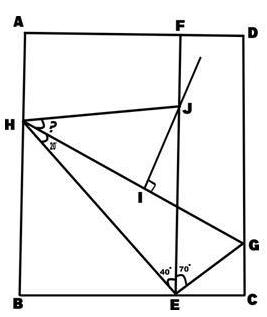
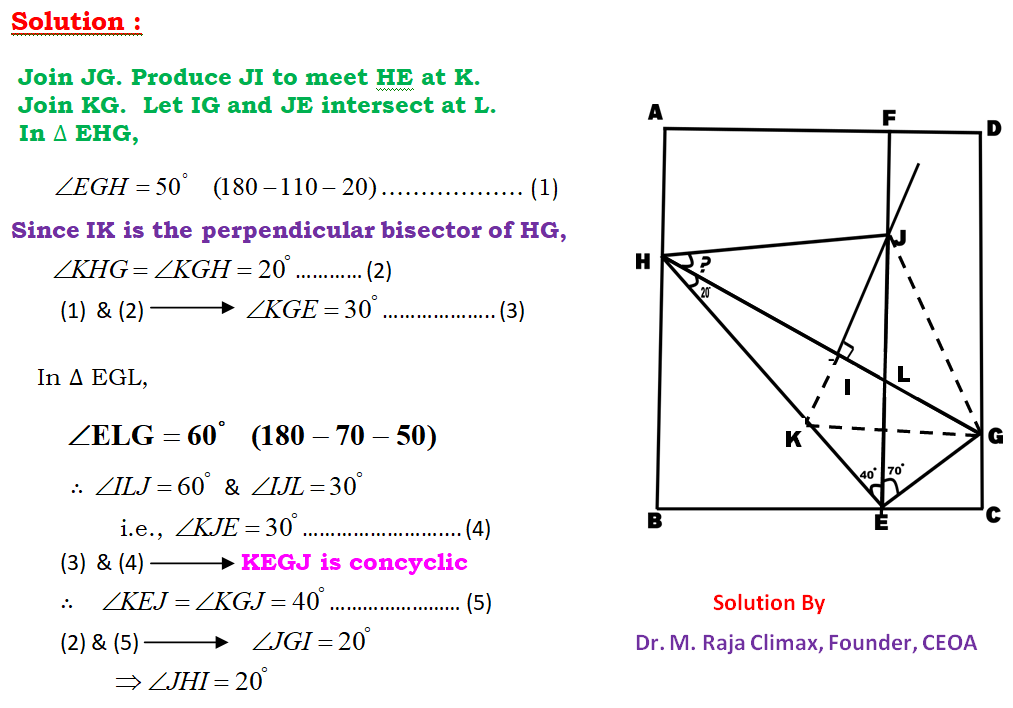
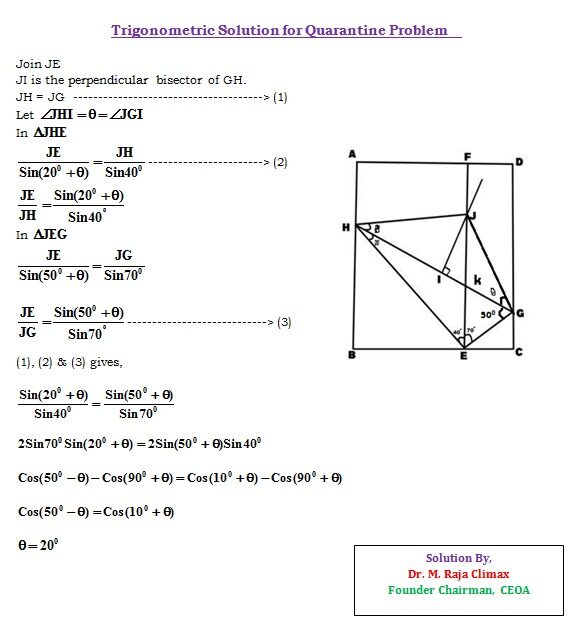
A house was to be quarantined by sealing its entrance. The entrance was a rectangular frame ABCD as shown in the picture. First, the point E was chosen on BC. From E a wooden stick was perpendicularly affixed touching AD at F. Then, from E another wooden stick was affixed touching DC at G such that <FEG = 70°. Another wooden stick was affixed at E touching AB at H such that <HEF = 40°. Another wooden stick was nailed joining HG. <EHG = 20° Then the midpoint of HG was located at I. From I, another wooden stick was perpendicularly affixed and crossing EF at J. Another wooden stick was affixed joining JH. Find the measurement of <JHI.
Problem created by
Dr.M.Raja Climax, FOUNDER CHAIRMAN, CEOA
3. Question:

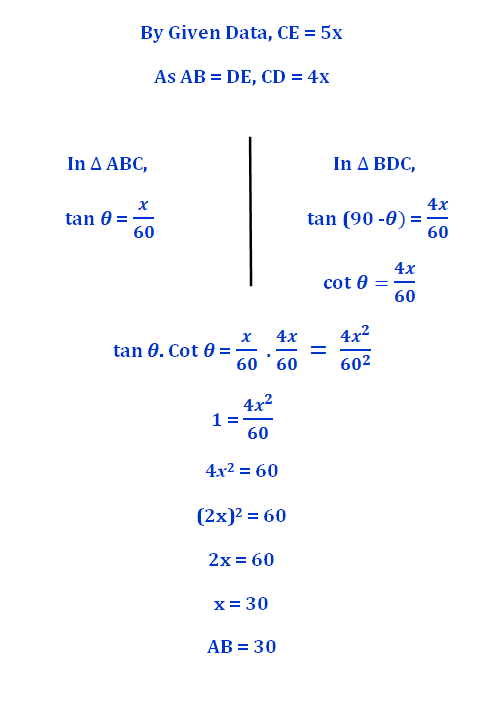
A tower and a lamp post are standing with a distance of 60
ft between them. A flag post is standing on the top of the
tower. The flag post and the lamp post are of equal
heights. The ratio between the height of the lamp post and
that of the tower (including the flag post) is 1: 5. The angle
of elevation of the top of the lamp post from the bottom of
the tower is @ degree. The angle of elevation of the bottom
of the flag post (top of the tower) from the bottom of the
lamp post is (90 — @) degree. Find the height of the lamp
post.
AB = Lamp post
CD = Tower
DE = Flag post
AB=?
Rules: Formula / Theorem learnt after X std should not be used.
Clark's or other Tables should not be used.
- Dr. M. Rajaclimax Founder Chairman
4. Question:
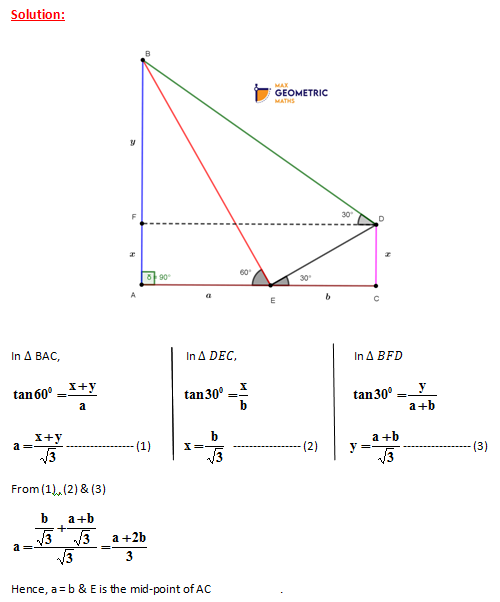
AB & CD are a tower & a pole respectively standing on a straight road. A & B are the bottom & top of the tower respectively and C &D are the bottom & top of the pole respectively. E is a point on the same road lying between A & C. The angles of elevation of B & D from E are measured as 600 & 300 respectively. The angle of elevation of B from D is measured as 300. Then, prove that E is the mid-point of AC.
5. Question:
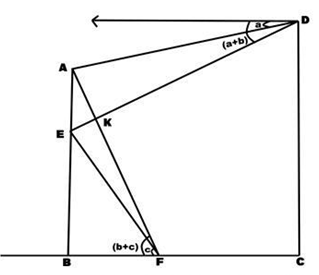
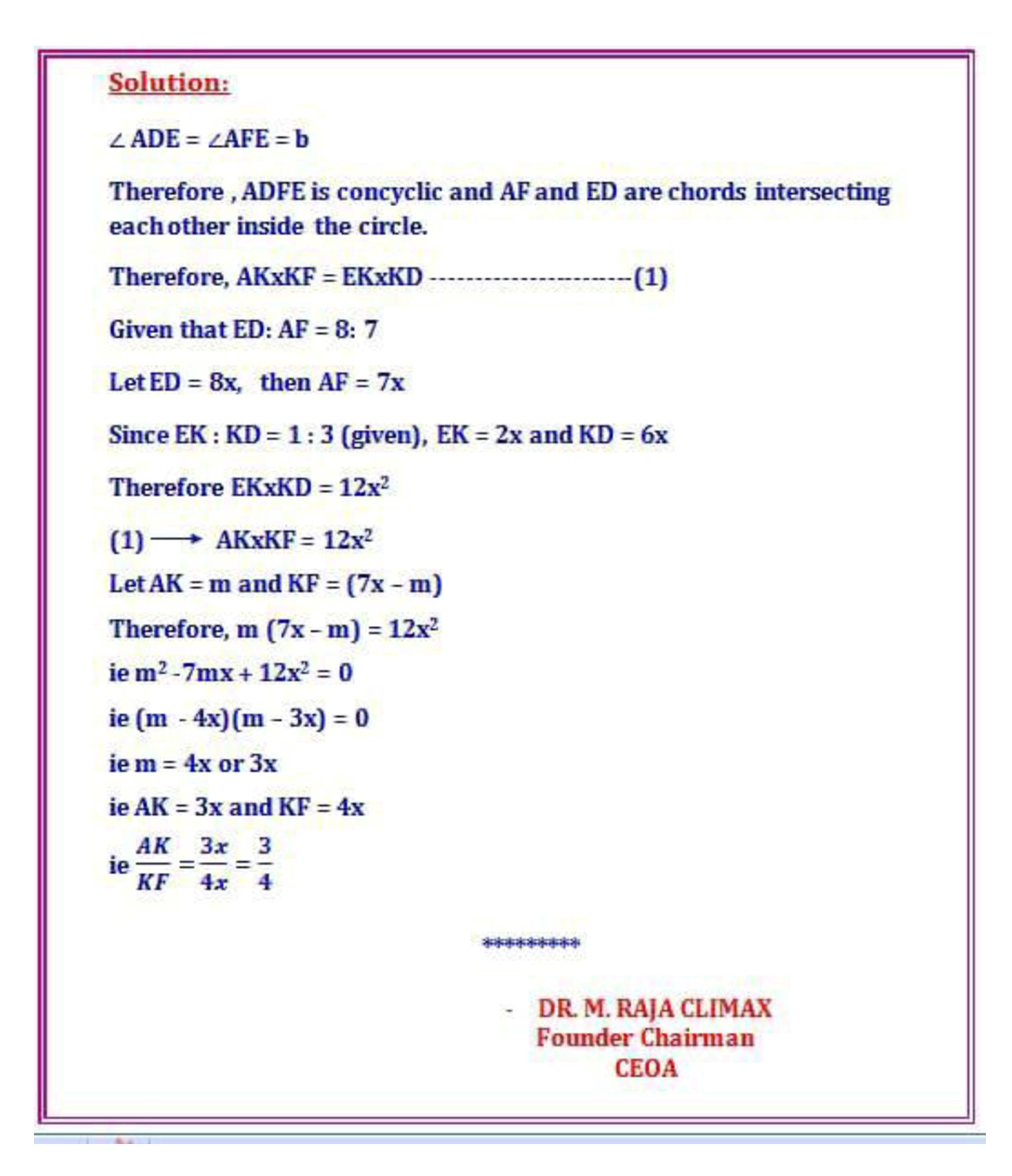
A tower AB (with a flag post AE on its top) and a light house CD are standing apart as shown in the picture. F is a point on the straight line joining B & C. AF and DE are joined with the help of ropes intersecting each other at K. From F, the angles of elevation of E& A are measured as c° & (b+c)° respectively. From D, the angles of depression of A & E are measured as a° & (a+b)° respectively. ED: AF = 8:7, EK: KD = 1:3. Find the ratio of AK: KF.
- Dr.M.Raja Climax
6. Question: